





•New


To be included in an exhibition opening 29 February
UPC Team Creates First High-Quality 3D Virtual Reproduction of Ripoll Monastery Doorway
The world’s largest model of a historical building, developed in conjunction with the National Art Museum of Catalonia (MNAC), shows previously imperceptible details of a Romanesque monastery.
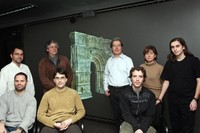

The Modelling, Visualization and Interaction in Graphics Research Group of the Department of Software at the Technical University of Catalonia (UPC) has created a three-dimensional model of the doorway of Ripoll’s Monastery of Santa Maria. In this project, the first of its kind anywhere in the world, the researchers used cutting-edge technologies to model the building in 3D. The result is a faithful digital reproduction of this jewel of the Catalan Romanesque period. The team’s challenge was to create a computerized 3D model depicting the doorway of the monastery, with sub-millimetre accuracy and maximum resolution, which would allow virtual users to view and understand every detail of the building. Created in conjunction with the National Art Museum of Catalonia (MNAC) and the Italian National Research Council of Pisa, the virtual model allows viewers to see the doorway from previously impossible viewpoints. It will be on display at the MNAC exhibition Romanesque Art and the Mediterranean: Catalonia, Toulouse and Pisa (1120-1180), which opens 29 February.
In addition to its cultural, educational and documentary value, this project will be of interest to experts in archaeology and heritage conservation. As the director of the project, UPC Informatics Professor Pere Brunet led a team of ten researchers based in Barcelona and Pisa. The researchers obtained high-resolution data from a thorough scan of the monastery’s doorway. They then processed this data in order to generate a specially designed computer model. Using highly sophisticated computer algorithms, the researchers were able to interact with all of this information on a single computer. They used a technical procedure that ensures maximum visual quality and faithfulness to the original. The spectacular results make it possible to walk through the doorway—almost literally—and view any detail from a distance of 20 cm. The model is fully interactive and does not require users to follow pre-set ‘tours’.
This virtual reconstruction is based on a 3D geometric model of the monastery’s doorway. Unlike ordinary audiovisual presentations, this model allows interactive inspection of the building. This interactivity opens up new possibilities in the study and understanding of sculptural elements. The interface provides a ‘virtual lantern’ that casts shadows on small details of the stone surface to allow better observation and greater understanding.
The system also includes information associated with various parts of the surface. Explanatory texts and old photographs reveal the condition of the doorway at different points in history. This background information helps viewers understand what they are seeing.
The virtual model is the result of a long process that began with a laser scan of the monastery’s doorway. For the purposes of this scan, the doorway was divided into 2,000 squares measuring 30 x 30 cm. For each square, a virtual mesh with sub-millimetre accuracy was obtained. The next step was to put together all of these pieces. This giant jigsaw puzzle contained a total of 850 million points, each assigned its true colour. The result was a unique 3D model of the doorway.
The model occupies around 56 GB, which is the information equivalent of a one-million page book. It consists of a mesh of 180 million triangles, which represent the doorway with maximum precision. This mesh can represent the doorway at various different resolutions, thereby offering superb visual quality from any viewpoint. As a result, the visual perception is identical to what we would see standing in front of the monastery.
With the new 3D model, viewers can use stereoscopic techniques to move and fly in front of the monastery and see details of the doorway from perspectives that would be impossible in the real world. The image of these details is complemented by educational, textual and historic information about the context and significance of the stone carvings, as well as about how they have changed over time. This background information includes Biblical texts with detailed illustrations and miniatures from the Bible of Ripoll, which were used as visual models for some of the relief sculptures. Also included are photographs taken during the first third of the 20th century, which offer a glimpse of the condition of the stone during previous stages in the degradation process.
This is the first 3D model with real-time interaction (more than 50 frames per second) that can be viewed with maximum resolution on any computer. This achievement was made possible by algorithms and computer programs developed by the UPC research team.
The project carried out by UPC’s Modelling, Visualization and Interaction in Graphics Research Group has made it possible for temporary exhibitions to include works of art that cannot be moved from their location but which are essential to understanding the art of a particular period. Virtual reality therefore provides a new way of learning about history and historical monuments.
+ Links
Follow us on Twitter