





•New

Share


EPSEM researchers use bacteria to recover metals from discarded mobile phones for reuse
A team of researchers at the Department of Mining, Industrial and ICT Engineering (EMIT) of the Universitat Politècnica de Catalunya (UPC) are exploring the potential of bioleaching as a technique for recovering metals from electronic waste from mobile phones. The technique could easily be adapted for use with other kinds of electronic waste, such as televisions, computers and refrigerators.

11/04/2016
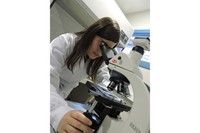
Bioleaching—a process in which microorganisms feed on the metal in the circuit boards of mobile phones to eliminate what has no value and recycle recoverable metals—is the subject of research by a group of investigators at the Department of Mining, Industrial and ICT Engineering of the Universitat Politècnica de Catalunya (UPC), based at the Manresa School of Engineering (EPSEM) and led by Antonio David Dorado, Montserrat Solé and Xavier Gamisans.
The process involves putting electronic waste containing metals of interest—copper, gold, chromium, zinc, nickel and aluminium, among others—in contact with iron-oxidising bacteria to extract the metals for reuse. Instead of chemically attacking the waste, the process harnesses the oxidising ability of some microorganisms. The extraction agents used are regenerated, and use of reagents and high temperatures is reduced.
The process is starting to be used with printed circuit boards from mobile phones, but experts say it could easily be adapted for use with other kinds of electronic waste, such as televisions, computers and refrigerators.
Less polluting and more economicalBioleaching is less polluting and more economical than processes currently in use and can be applied at low metal concentrations, conditions in which other techniques would not be viable. For the process to work, factors that affect the activity of the microorganisms, such as pH, temperature, and the concentration of salts, must be controlled. Bioleaching yields a solution containing the metals, which can then be recovered by means of a separation process and reused in circuit boards or other applications.
The most commonly used bacterial species, Acidithiobacillus ferrooxidans, grows in very adverse (and uncommon) conditions. It is found in nature in environments such as urban waste water. The researchers collected samples from such environments and treated them in a laboratory under conditions designed to ensure that only this species would survive and reproduce. Other microorganisms and communities that are generating good results within a reasonable time frame are also being investigated.
The microorganisms make it possible to extract materials that can be reused, and which if not removed could damage water and soil at disposed sites. The process reduces the need to exploit natural resources to obtain the large amounts of metals, such as copper, used in electronic technology.
The research results show that under certain conditions the use of microorganisms can increase the amount of metal recovered by 30%, facilitating the recovery of 99% of waste. Recovery is more cost-effective than mining because the concentration of metals in waste material is higher than in mineral ores. It is also a good way to treat waste that would otherwise be very difficult to dispose of safely.
At this point, the researchers are trying to work out how the extraction process can be improved to make it viable for industrial use.
The process involves putting electronic waste containing metals of interest—copper, gold, chromium, zinc, nickel and aluminium, among others—in contact with iron-oxidising bacteria to extract the metals for reuse. Instead of chemically attacking the waste, the process harnesses the oxidising ability of some microorganisms. The extraction agents used are regenerated, and use of reagents and high temperatures is reduced.
The process is starting to be used with printed circuit boards from mobile phones, but experts say it could easily be adapted for use with other kinds of electronic waste, such as televisions, computers and refrigerators.
Less polluting and more economical
The most commonly used bacterial species, Acidithiobacillus ferrooxidans, grows in very adverse (and uncommon) conditions. It is found in nature in environments such as urban waste water. The researchers collected samples from such environments and treated them in a laboratory under conditions designed to ensure that only this species would survive and reproduce. Other microorganisms and communities that are generating good results within a reasonable time frame are also being investigated.
The microorganisms make it possible to extract materials that can be reused, and which if not removed could damage water and soil at disposed sites. The process reduces the need to exploit natural resources to obtain the large amounts of metals, such as copper, used in electronic technology.
The research results show that under certain conditions the use of microorganisms can increase the amount of metal recovered by 30%, facilitating the recovery of 99% of waste. Recovery is more cost-effective than mining because the concentration of metals in waste material is higher than in mineral ores. It is also a good way to treat waste that would otherwise be very difficult to dispose of safely.
At this point, the researchers are trying to work out how the extraction process can be improved to make it viable for industrial use.
Follow us on Twitter