





•New

Share


In the 2016-2017 academic year the ESEIATT will offer ten bachelor's degrees, seven master's degrees and four doctoral programmes
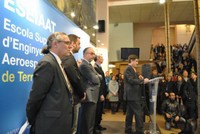
Opening of the new Terrassa School of Industrial, Aerospace and Audiovisual Engineering (ESEIAAT)
The ESEIAAT aims to be one of the largest engineering schools in Catalonia and Spain, and a strategic reference for the industrial, economic and social fabric at home and abroad.

18/02/2016
The new Terrassa School of Industrial, Aerospace and Audiovisual Engineering (ESEIAAT) of the Universitat Politècnica de Catalunya (UPC) has 4,100 bachelor's, master's and doctoral students, 450 professors and researchers, and 34 research groups. It is a centre for education, research and technology transfer with expertise in the fields of industrial, aerospace and audiovisual engineering. It was created through the merging of the two engineering schools on the Terrassa Campus: the Terrassa School of Industrial and Aeronautical Engineering (ETSEIAT) and the Terrassa School of Engineering (EET).
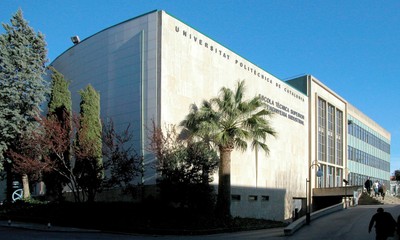
The new school will be located in the premises formerly occupied by the EET and the ETSEIAT and its central offices will be in the "Historic Building" at Carrer Colom 1, Terrassa. As of the 2016-2017 academic year its course offering will cover areas that are important to Catalonia, with ten bachelor's degrees, seven master's degrees (two of them taught entirely in English) and four doctoral programmes.
The merger of the two schools is part of two strategic processes for the UPC: the reviewing and planning of the University's course map; and the structural transformation of the University with the aim of providing a better service to students and society in general. The merger will take advantage of the schools’ expertise and prestige and streamline their resources and management through a management and support unit.
The ESEIAAT will be managed by Miguel Mudarra, former director of the ETSEIAT, and Xavier Cañavate, former director of the EET, who is the rector's delegate for the merger of the two schools and for the Terrassa Campus.
 The ESEIAAT offers a wide and well-defined range of bachelor's and master's degrees and plans to offer an increasing number of postgraduate courses. It is the only school in Catalonia and one of three in the Spanish State that offers a bachelor's degree in Aerospace Technology Engineering. It is the only school belonging to a university in Spain that offers the bachelor's degree in Textile Technology and Design Engineering and it was the first public university to introduce the bachelor's degree in Audiovisual Systems Engineering and the bachelor's degree in Industrial Design and Product Development Engineering (the latter is also offered by the UPC's Vilanova i la Geltrú School of Engineering).
Other assets of the ESEIAAT are its high level of internationalisation, its strong research drive and the quality of its doctoral programmes.
The new school was officially created on 11 November 2015, with the approval of the Government of Catalonia and its publication in the Official Gazette of the Catalan Government (Order ECO/ 342/2015). It is the culmination of a process that was started in spring 2015 by the Governing Council, headed by Rector Enric Fossas, at the first meetings with the management of the EET and the ETSEIAT. The boards of both schools gave their support to the process, which was finally approved by the Governing Council of the UPC in July 2015.
The two engineering schools already maintained a high degree of collaboration, sharing laboratories, teaching staff, campus services and a cross-departmental structure.
The new school occupies 11 buildings located between numbers 1 and 11 of Carrer Colom, Terrassa with a floor area of about 31,000 m2, including 16,500 m2 for teaching, 10,400 m2 for research and over 4,000 m2 for services.
Bachelor's degrees: The ESEIAAT offers the possibility of supplementing a degree with a specific pathway for obtaining a double degree at the School. Two double bachelor's degrees and one double master's degree can also be taken with the Open University of Catalonia.
In addition, students can take international double master's degrees, one with the Politecnico di Torino and one with the School of Arts, Sciences and Humanities (EACH) of the Universidade de São Paulo. The ESEIAAT has academic agreements that allow students to study for a master's degree at the ESEIAAT and at one of the following foreign universities: the Institut supérieur de l'aéronautique et de l'espace in Toulouse, HEC and the École d'Ingénieurs-ESTACA in Paris, Cranfield University in the UK, the Illinois Institute of Technology in Chicago and the University of California-Irvine.
The ESEIAAT will present the course offering, career opportunities and facilities during the open days aimed especially at secondary school students to be held on 30 March, 20 April and 14 and 25 May. The offer of bachelor's degrees will also be presented at the UPC's stand at the Education Fair from 9 to 13 March in the Montjuïc Exhibition Centre of Fira de Barcelona. The ESEIAAT's master's degrees will be promoted at the Futura Fair in the Montjuïc Exhibition Centre on 11 and 12 March.
The work of these groups has also led to ten spin-offs related to industrial engineering on the Terrassa Campus, including Baolab, Biprocel, CSC Flubetech, IbQ, MicroPaP, MRGLab, RDmes and Venginyers.
 The ESEIAAT was created from the merger of two schools with a long history, which have adapted and innovated to meet the needs of education and research at a local and international level. They have forged alliances in education, technology transfer and knowledge with the industrial and social players in the region, in Europe and in the rest of the world.
Specialising in engineering education, the two schools that have merged to create the ESEIAAT have shown outstanding prestige and quality, and an excellent position in the national rankings. They have received awards in innovation and teaching quality from the UPC and from other institutions and organisations, and many of their students have received awards in the fields of engineering, business and public administration.
The two schools have been instrumental in the development of the productive fabric of Catalonia and their graduates have led and currently lead industry, technological innovation and the productive economy in the region. They have a graduate employment rate of about 90% according to the 2013 Graduate Employment Survey of the Catalan University Quality Assurance Agency (AQU), and their jobs are of high quality. The education they have received is therefore in line with the needs of society. The same survey reveals a high degree of satisfaction of students: 85% of graduates would choose the school again.
The School has about a thousand educational cooperation agreements, through which the students do work placement in companies and institutions to contribute to their education and facilitate their integration in the labour market. The School also promotes international student mobility programmes: 200 students follow one of these programmes outside Spain and in the last year the School received 150 international exchange students.
The ESEIAAT has also inherited from both schools initiatives to promote talent and entrepreneurship among students through interdisciplinary projects. For example, important projects within the INSPIRE3 programme include the ecoRZ electric car, which competed in the international Formula Student competition; the Creative Lab, a joint educational initiative with Volkswagen and SEAT; and FabLab, a new laboratory and co-working space for 3D production in which students can carry out their projects. One of these actions received the 2015 elEconomista Prize for the best teaching initiative.
The educational approach fosters the development of talent. Many students have won awards in competitions, such as that organised by NISSAN, the magazine Autopista and the Universitat Politècnica de València, the Innovation Awards of the Cotton Textile Foundation, the international Electrolux Design Lab competition and the Roca One Day Design Challenge.
The School's relations with local industry are shown by the grants for students with the best academic records awarded by the Catalan Textile Association; the Telstar Chair of Innovation and Vacuum Technology, set up in 2008 as the first enterprise chair on the Terrassa Campus and the first chair in Catalonia in this speciality; and the Schneider Electric Classroom, which provides practical training in science and technology. The company Festo also supports the E-Motion Automation competition that is being piloted at the ESEIAAT.
Origins of the EET and the ETSEIATThe EET has its origins in the Terrassa School of Industries, created by the Royal Decree of 17 August 1901 to offer courses in Industrial Mechanics, Electricity and Chemistry, Industrial Practice and Industrial Techniques for Workers. The specialisation of Manufacturing Engineering (later known as Textile Engineering) was established by the Royal Decree of 10 January 1902. In the following year the first textile school in Spain was opened in a provisional building at Carrer Topete, 4. In July 1904 the School moved to its current premises at Carrer Colom 1, a building designed by the Catalan Modernista architect Lluis Muncunill i Domenech and known as the “Historic Building”.
The first students of Industrial and Textile Engineering graduated in 1906. In 1972, the School became part of the Universitat Politècnica de Barcelona, currently the UPC, and is name was changed to the College of Industrial Engineering of Terrassa (EUETIT). In 2010 its name was changed again to the Terrassa School of Engineering (EET). Over the years, this school has offered courses in various fields of engineering and has forged close ties with the town of Terrassa, its factories and its workers.
The ETSEIAT has its origins in the approval of the Regulations of the Terrassa School of Industries by the Ministry of Public Instruction on 8 May 1904. In the same year the Terrassa School of Industries was authorised to enrol first-year students in Textile Industry Engineering. However, the three levels of education (elementary, middle and higher) formed part of a single structure until the Board of the Terrassa Textile Industry Engineering School was set up in 1947. In 1957 it was renamed the Terrassa Higher School of Industrial Engineering, Textile Section.
In 1962 it became independent from the Terrassa School of Industries and moved to its current premises at Carrer Colom 11. In 1966 it became the School of Industrial Engineering (ETSEIT), with new industrial specialities: mechanical engineering and business management. In 1968 the Polytechnic Institute of Barcelona, composed of the Barcelona engineering schools, the ETSEIT and the Barcelona School of Architecture, was set up. It later became the Universitat Politècnica de Barcelona, and finally the UPC.
The courses that were established as of 1977 have survived several curricular transformations. Aeronautical Engineering courses were introduced in 2004-2005, so on 15 September 2005 the name was changed to Terrassa School of Industrial and Aeronautical Engineering (ETSEIAT), marking the final organisation of the courses, research and technology transfer.
The new school will be located in the premises formerly occupied by the EET and the ETSEIAT and its central offices will be in the "Historic Building" at Carrer Colom 1, Terrassa. As of the 2016-2017 academic year its course offering will cover areas that are important to Catalonia, with ten bachelor's degrees, seven master's degrees (two of them taught entirely in English) and four doctoral programmes.
The merger of the two schools is part of two strategic processes for the UPC: the reviewing and planning of the University's course map; and the structural transformation of the University with the aim of providing a better service to students and society in general. The merger will take advantage of the schools’ expertise and prestige and streamline their resources and management through a management and support unit.
The ESEIAAT will be managed by Miguel Mudarra, former director of the ETSEIAT, and Xavier Cañavate, former director of the EET, who is the rector's delegate for the merger of the two schools and for the Terrassa Campus.
An engineering cluster in Terrassa
The ESEIAAT’s goal is to become a local and international reference in the fields of industrial, aerospace and audiovisual engineering and to establish itself as an engineering cluster in Terrassa. It aims to be a modern, innovative school with close ties to the outside world.The ESEIAAT offers a wide and well-defined range of bachelor's and master's degrees and plans to offer an increasing number of postgraduate courses. It is the only school in Catalonia and one of three in the Spanish State that offers a bachelor's degree in Aerospace Technology Engineering. It is the only school belonging to a university in Spain that offers the bachelor's degree in Textile Technology and Design Engineering and it was the first public university to introduce the bachelor's degree in Audiovisual Systems Engineering and the bachelor's degree in Industrial Design and Product Development Engineering (the latter is also offered by the UPC's Vilanova i la Geltrú School of Engineering).Other assets of the ESEIAAT are its high level of internationalisation, its strong research drive and the quality of its doctoral programmes.
The new school was officially created on 11 November 2015, with the approval of the Government of Catalonia and its publication in the Official Gazette of the Catalan Government (Order ECO/ 342/2015). It is the culmination of a process that was started in spring 2015 by the Governing Council, headed by Rector Enric Fossas, at the first meetings with the management of the EET and the ETSEIAT. The boards of both schools gave their support to the process, which was finally approved by the Governing Council of the UPC in July 2015.
The two engineering schools already maintained a high degree of collaboration, sharing laboratories, teaching staff, campus services and a cross-departmental structure.
The new school occupies 11 buildings located between numbers 1 and 11 of Carrer Colom, Terrassa with a floor area of about 31,000 m2, including 16,500 m2 for teaching, 10,400 m2 for research and over 4,000 m2 for services.
Bachelor's degrees:
• Bachelor's degree in Industrial Design and Product Development Engineering
• Bachelor's degree in Audiovisual Systems Engineering
• Bachelor's degree in Textile Technology and Design Engineering
• Bachelor’s degree in Electrical Engineering
• Bachelor's degree in Industrial Electronics and Automatic Control Engineering
• Bachelor's degree in Aerospace Technology Engineering
• Bachelor's degree in Industrial Technology Engineering
• Bachelor's degree in Aerospace Vehicle Engineering
• Bachelor’s degree in Mechanical Engineering
• Bachelor's degree in Chemical Engineering
Postgraduate studies (master's degrees and doctoral programmes):• Bachelor's degree in Audiovisual Systems Engineering
• Bachelor's degree in Textile Technology and Design Engineering
• Bachelor’s degree in Electrical Engineering
• Bachelor's degree in Industrial Electronics and Automatic Control Engineering
• Bachelor's degree in Aerospace Technology Engineering
• Bachelor's degree in Industrial Technology Engineering
• Bachelor's degree in Aerospace Vehicle Engineering
• Bachelor’s degree in Mechanical Engineering
• Bachelor's degree in Chemical Engineering
• Master's degree in Aeronautical Engineering
• Master's degree in Management Engineering
• Master's degree in Automatic Systems Engineering and Industrial Electronics
• Master's degree in Industrial Engineering
• Master's degree in Textile and Paper Engineering
• Master's Degree in Aerospace and Aeronautical Engineering
• Master's Degree in Technology and Engineering Management
• Doctoral degree in Mechanical, Fluids and Aerospace Engineering
• Doctoral degree in Thermal Engineering
• Doctoral degree in Textile and Paper Engineering
• Doctoral degree in Electric Energy Systems
• Master's degree in Management Engineering
• Master's degree in Automatic Systems Engineering and Industrial Electronics
• Master's degree in Industrial Engineering
• Master's degree in Textile and Paper Engineering
• Master's Degree in Aerospace and Aeronautical Engineering
• Master's Degree in Technology and Engineering Management
• Doctoral degree in Mechanical, Fluids and Aerospace Engineering
• Doctoral degree in Thermal Engineering
• Doctoral degree in Textile and Paper Engineering
• Doctoral degree in Electric Energy Systems
Double degrees
The ESEIAAT offers the possibility of supplementing a degree with a specific pathway for obtaining a double degree at the School. Two double bachelor's degrees and one double master's degree can also be taken with the Open University of Catalonia.In addition, students can take international double master's degrees, one with the Politecnico di Torino and one with the School of Arts, Sciences and Humanities (EACH) of the Universidade de São Paulo. The ESEIAAT has academic agreements that allow students to study for a master's degree at the ESEIAAT and at one of the following foreign universities: the Institut supérieur de l'aéronautique et de l'espace in Toulouse, HEC and the École d'Ingénieurs-ESTACA in Paris, Cranfield University in the UK, the Illinois Institute of Technology in Chicago and the University of California-Irvine.
The ESEIAAT will present the course offering, career opportunities and facilities during the open days aimed especially at secondary school students to be held on 30 March, 20 April and 14 and 25 May. The offer of bachelor's degrees will also be presented at the UPC's stand at the Education Fair from 9 to 13 March in the Montjuïc Exhibition Centre of Fira de Barcelona. The ESEIAAT's master's degrees will be promoted at the Futura Fair in the Montjuïc Exhibition Centre on 11 and 12 March.
Cutting-edge research
The ESEIAAT's research, innovation and knowledge transfer is organised through 34 research centres, groups and laboratories, which are listed below. Nine of them are members of the TECNIO network of the Government of Catalonia* and, of the nine, eight belong to the UPC's Innovation and Technology Centre (CIT UPC)**. • Catalan Plastics Centre (CCP)*
• Food Safety and Control Centre (CRESCA):
• Structural Integrity, Micromechanics and Materials Reliability Centre (CIEFMA)**
• Heat and Mass Transfer Technological Centre (CTTC)**
• Motion Control and Industrial Applications Research Group (MCIA)**
• Molecular and Industrial Biotechnology Group (GBMI)
• Integrated Production Control and Management Group (CGIP)
• Nonlinear Dynamics, Nonlinear Optics and Lasers Group (DONLL)
• Lightning Research Group (LRG)
• Applied Analysis Research Group (GRAA)
• Game Theory Research Group (GRTJ)
• Construction Research and Innovation Group (GRIC)
• Paper and Graphics Research Group (CIPAGRAF-CELBIOTECH)
• Thermodynamics and Physical Chemistry Research Group (TERFIQ)
• Advanced Control Systems Group (SAC)
• Renewable Electrical Energy Systems Group (SEER)**
• Surfaces, Products and Textile Processes Group (SPPT)
• Polymer and Composite Technology Research Group (POLYCOM)
• Terrassa Industrial Electronics Group (TIEG)
• The Innotex Centre (HEL)**, which includes the Toxicology Research and Innovation Centre (CRIT), the Technical Spinning Centre (CTF) and the Terrassa Institute of Textile Research and Industrial Cooperation (INTEXTER). INTEXTER is composed of the Environmental Engineering and Microbiology Group (GEMMA) the Polymeric Materials and Textile Chemistry Group (POLQUITEX), the Textile Technology Research Group (TECTEX) and the Environmental and Health Toxicology and Microbiology Group (TMAS/T+) and the Advanced Composite Material Laboratory (COMPOLAB)
• Aeronautical and Industrial Research and Studies Laboratory (AIRE-CRAE)
• Physics of Dielectric Materials Laboratory (DILAB)
• Sustainability Measurement and Modelling Laboratory (SUMM Lab)
• Environmental and Health Toxicology and Microbiology Laboratory (MSM Lab)
• Fluid Power Systems Laboratory (LABSON)**
• Electrochemistry, Interfaces and Nanometric Films Laboratory (LEIPN)
• Acoustic and Mechanical Engineering Laboratory (LEAM)**
• Laboratory for Technological Innovation in Structures and Materials (LITEM)
These research groups have been involved in several national and international R&D projects, including the VERDE project to create the first green car; the VEUREE project to design a new high-performance electric vehicle; the iTesTiT project to design technology that detects and predicts failures in wind turbines; and the ECUVal project to design a system to save 70% to 100% of water in the textile dyeing process. • Food Safety and Control Centre (CRESCA):
• Structural Integrity, Micromechanics and Materials Reliability Centre (CIEFMA)**
• Heat and Mass Transfer Technological Centre (CTTC)**
• Motion Control and Industrial Applications Research Group (MCIA)**
• Molecular and Industrial Biotechnology Group (GBMI)
• Integrated Production Control and Management Group (CGIP)
• Nonlinear Dynamics, Nonlinear Optics and Lasers Group (DONLL)
• Lightning Research Group (LRG)
• Applied Analysis Research Group (GRAA)
• Game Theory Research Group (GRTJ)
• Construction Research and Innovation Group (GRIC)
• Paper and Graphics Research Group (CIPAGRAF-CELBIOTECH)
• Thermodynamics and Physical Chemistry Research Group (TERFIQ)
• Advanced Control Systems Group (SAC)
• Renewable Electrical Energy Systems Group (SEER)**
• Surfaces, Products and Textile Processes Group (SPPT)
• Polymer and Composite Technology Research Group (POLYCOM)
• Terrassa Industrial Electronics Group (TIEG)
• The Innotex Centre (HEL)**, which includes the Toxicology Research and Innovation Centre (CRIT), the Technical Spinning Centre (CTF) and the Terrassa Institute of Textile Research and Industrial Cooperation (INTEXTER). INTEXTER is composed of the Environmental Engineering and Microbiology Group (GEMMA) the Polymeric Materials and Textile Chemistry Group (POLQUITEX), the Textile Technology Research Group (TECTEX) and the Environmental and Health Toxicology and Microbiology Group (TMAS/T+) and the Advanced Composite Material Laboratory (COMPOLAB)
• Aeronautical and Industrial Research and Studies Laboratory (AIRE-CRAE)
• Physics of Dielectric Materials Laboratory (DILAB)
• Sustainability Measurement and Modelling Laboratory (SUMM Lab)
• Environmental and Health Toxicology and Microbiology Laboratory (MSM Lab)
• Fluid Power Systems Laboratory (LABSON)**
• Electrochemistry, Interfaces and Nanometric Films Laboratory (LEIPN)
• Acoustic and Mechanical Engineering Laboratory (LEAM)**
• Laboratory for Technological Innovation in Structures and Materials (LITEM)
The work of these groups has also led to ten spin-offs related to industrial engineering on the Terrassa Campus, including Baolab, Biprocel, CSC Flubetech, IbQ, MicroPaP, MRGLab, RDmes and Venginyers.
A long history and a future vision
The ESEIAAT was created from the merger of two schools with a long history, which have adapted and innovated to meet the needs of education and research at a local and international level. They have forged alliances in education, technology transfer and knowledge with the industrial and social players in the region, in Europe and in the rest of the world. Specialising in engineering education, the two schools that have merged to create the ESEIAAT have shown outstanding prestige and quality, and an excellent position in the national rankings. They have received awards in innovation and teaching quality from the UPC and from other institutions and organisations, and many of their students have received awards in the fields of engineering, business and public administration.
The two schools have been instrumental in the development of the productive fabric of Catalonia and their graduates have led and currently lead industry, technological innovation and the productive economy in the region. They have a graduate employment rate of about 90% according to the 2013 Graduate Employment Survey of the Catalan University Quality Assurance Agency (AQU), and their jobs are of high quality. The education they have received is therefore in line with the needs of society. The same survey reveals a high degree of satisfaction of students: 85% of graduates would choose the school again.
The School has about a thousand educational cooperation agreements, through which the students do work placement in companies and institutions to contribute to their education and facilitate their integration in the labour market. The School also promotes international student mobility programmes: 200 students follow one of these programmes outside Spain and in the last year the School received 150 international exchange students.
The ESEIAAT has also inherited from both schools initiatives to promote talent and entrepreneurship among students through interdisciplinary projects. For example, important projects within the INSPIRE3 programme include the ecoRZ electric car, which competed in the international Formula Student competition; the Creative Lab, a joint educational initiative with Volkswagen and SEAT; and FabLab, a new laboratory and co-working space for 3D production in which students can carry out their projects. One of these actions received the 2015 elEconomista Prize for the best teaching initiative.
The educational approach fosters the development of talent. Many students have won awards in competitions, such as that organised by NISSAN, the magazine Autopista and the Universitat Politècnica de València, the Innovation Awards of the Cotton Textile Foundation, the international Electrolux Design Lab competition and the Roca One Day Design Challenge.
The School's relations with local industry are shown by the grants for students with the best academic records awarded by the Catalan Textile Association; the Telstar Chair of Innovation and Vacuum Technology, set up in 2008 as the first enterprise chair on the Terrassa Campus and the first chair in Catalonia in this speciality; and the Schneider Electric Classroom, which provides practical training in science and technology. The company Festo also supports the E-Motion Automation competition that is being piloted at the ESEIAAT.
Origins of the EET and the ETSEIAT
The first students of Industrial and Textile Engineering graduated in 1906. In 1972, the School became part of the Universitat Politècnica de Barcelona, currently the UPC, and is name was changed to the College of Industrial Engineering of Terrassa (EUETIT). In 2010 its name was changed again to the Terrassa School of Engineering (EET). Over the years, this school has offered courses in various fields of engineering and has forged close ties with the town of Terrassa, its factories and its workers.
The ETSEIAT has its origins in the approval of the Regulations of the Terrassa School of Industries by the Ministry of Public Instruction on 8 May 1904. In the same year the Terrassa School of Industries was authorised to enrol first-year students in Textile Industry Engineering. However, the three levels of education (elementary, middle and higher) formed part of a single structure until the Board of the Terrassa Textile Industry Engineering School was set up in 1947. In 1957 it was renamed the Terrassa Higher School of Industrial Engineering, Textile Section.
In 1962 it became independent from the Terrassa School of Industries and moved to its current premises at Carrer Colom 11. In 1966 it became the School of Industrial Engineering (ETSEIT), with new industrial specialities: mechanical engineering and business management. In 1968 the Polytechnic Institute of Barcelona, composed of the Barcelona engineering schools, the ETSEIT and the Barcelona School of Architecture, was set up. It later became the Universitat Politècnica de Barcelona, and finally the UPC.
The courses that were established as of 1977 have survived several curricular transformations. Aeronautical Engineering courses were introduced in 2004-2005, so on 15 September 2005 the name was changed to Terrassa School of Industrial and Aeronautical Engineering (ETSEIAT), marking the final organisation of the courses, research and technology transfer.
Follow us on Twitter